The Positive Death Movement Comes to Life - The New York Timeshttps://apple.news/A2wbA927tSja-oixSoWUkGQ
The Church Is...
They say the church is a hospital
I say it is a garden
They say it is for sinners
I say it is for plants
They say for the sick
I say for the growing
I wrote this some where back in the early 80's. Even then, my ideas about church were not mainstream. I guess I've always been a bit of a square peg in a round hole. I couldn't agree with what I thought was a simplistic view of church. And the hospital metaphor didn't work in many churches anyhow.It might have been a goal for some in leadership to bring healing to the members, but all too often, more hurt was brought than healing. How surprised was I when I found a church that was more healing than anything else. Not many of them. No, for me it was a place to grow. It took me a while to see that and connect it with discipleship, but disciples grow, victims may be healed but then what. I think the hospital metaphor falls short of what church is unless there is a growth metaphor to go with it. Psalm 1 is my inspiration for such growth. Just cleaning out some old files, think I'll keep this one for another 30 years. See what I think about church then.

Who Doesn't Like A Little Music?
When I play a spiritual song or hymn for someone, it usually does them good. I had a lady recently though that didn't appreciate me playing for her. She said, "If you're playing for my benefit, forget about it."
Imagine her in a New York accent saying Fuggedaboutit! Well, it was funny, I avoided laughing, but it was funny. A little sad too. Maybe it's one of the last signs of a vital life, that the music no longer means anything.
My recommendation is simple, keep the music going. Heaven will be full of music.
Do you feel that?

These are untidy subjects to write about. Feelings, actions, reactions, responses, responsibilities, perspective. They are all tied together and affect each other. We act or react often based on our feelings. We may have very little accurate information, but we go ahead anyhow. That’s because our feelings of fear have more control over our actions than our feelings of peace or stasis.
A glance or a look from someone is enough to set our minds into overdrive about what they are thinking or what did they say about me. Like a pinball, thoughts zip back and forth in our mind. They usually run dark and they end up negative. It’s a sort of threat assessment.
If we’ve been hurt enough in life, then we’ve learned that people are the source of most of that hurt. It’s a wonder that some people ever develop healthy relationships after all the suffering they have been through. Changing our feelings is a tough process. To believe that everyone is not out to hurt you requires a courage to be vulnerable. This does not come easy. Not after repeated hurts.
How do we let our guard down? We must get better information. We must learn the difference between reality and perspective. We must understand why we feel what we feel. How do feelings shape our actions and reactions.
We would like to be seen in a favorable light, to have people positively impressed when they see us. That’s fairly normal. What’s not normal is living in fear that we will be seen negatively most of the time. What’s not normal is giving excessive care and thought to our image. Image management can severely interfere with living authentically.
What do you feel right now? Anger, frustration, anxiety, courage, innovative, risky, hungry, happy, elevated, miserly, bouncy, musical, boundless, energetic, disgusted, vengeful, determined, disciplined, euphoric, depressed, wild, balanced, smart, wise, churlish, peevish, delighted, tired, or raring to go.
Is that feeling based on perspective or tangible information? Many of our feelings invade our mind from unchecked sources. We can feel disgust at politicians just because they are politicians. Is that healthy or warranted? Police? Teachers? Animal control? Criminals?
Examining why we feel, what we feel, where those feelings came from and who they are directed at, will yield a gold mine of information about “FEELING” better.
Think about these words, perspective, reality, thoughts, feelings, actions, reactions, responses, living, hiding, authentic, fear and courage, love.
We all have a certain amount of time to devote to living fully. Those who live the fullest gain clarity over their feelings, the origin of those feelings, and managing those feelings for happier, healthier lives.
What were the prominent feelings of this past week and what are you feeling right now?
Feelings
This is a big topic and the science of feelings/emotions is growing. Here's an article to get us started.
https://www.scientificamerican.com/article/feeling-our-emotions/
Feelings have a lot of power in our lives. I'm exploring this subject a lot right now, partly because I have a large range of emotions in my work with the dying and partly because I see so many people who are led by the nose by some feeling and they have lost control of their behaviour. Sometimes the consequences of losing control because of our feelings is very serious. More importantly, how can we harness our feelings to improve our lives?
See
Do you see enough to see it all? Of course not. You don’t even see all that you think you see. Much more than we like to admit, our witness is second or third hand. We did not see, they saw. Yet, we take what they saw as if we saw it ourselves. We transform third or second hand sightings into personal observations, allowing them to inform our words and actions.
This sophistry is stupid and dangerous, larger than the loss of all the Lemmings lost to the sea.
What do you see? What have you heard? Return to the first person, yourself, in person. Judge life from there. Even there, with first hand knowledge, you still are an imperfect judge, but a better judge presumably.
News, fake or not, is vastly second hand. It is rarely good. The way it is dished up to us, it is instilling little more than anxiety and fear. When you think about how you feel after listening to the news, you might begin to wonder why you watch it anymore. Why does it have such mood swaying, depressing power over us?
Resolve to See for yourself.
The relation between what we see and what we know is never settled. Each evening we see the sun set. We know that the earth is turning away from it. Yet the knowledge, the explanation, never quite fits the sight.
John Berger
360
Life is all around us, but our eyes only look at part of it. Our ears capture a part. Our smell even more. These inputs are sense-able. Yet much goes unsensed. Growing up in a city made me more sympathetic to my senses. Survival in combat depends on our senses working alertly in all directions.
I wonder which is more joyful, a hyper sense, where gigabytes of data are taken in with a glance or a whiff of spring air, or a hypo sense, where little or nothing is noticed, our mind moving into hibernation?
I usually prefer the more active sense at work and play. Yet, I feel more vulnerable to sensory overload these days. Empty space in my senses does not feel very productive but it may be the only way to lasting productivity.
What do you sense? Your feelings depend on your senses. Feel the sun, smell the breeze, pull out the thorn. Use your senses, make sense of the surroundings. Live 360.
Ted Kooser Train
Ted Kooser wrote this over a decade ago but writings about time so easily become timeless. It's in his book Local Wonders. Take a read here at NPR.
The Train Of Life and welcoming your next year, even after cancer which Ted had. Then being greeted with upturned glasses, you are still alive.
Ted still lives, about 30 minutes from my home. I will turn up my glasses if I see him.
Right As Rain
The more people you see each day, the more you will be asked a version of "How are you Doing"?
How's it going, how's it hanging, wassup, etc. Of course, it's what we do. I usually like it. Heaven knows, let someone walk by you without some sort of greeting and you'll ask yourself, "What's up with them? They might be having a bad day, or maybe their upset with you. And away your mind goes for 20 minutes thinking, "Now what did I do"?
No, it's better off to just greet everybody and yes, ask them how they're doing. A few of us might even tell you the truth, skipping conventional responses, if we feel like whale scat, we'll tell you. If we feel like a million bucks, we'll tell you.
My latest response has been "Mostly Sunny" Both true and descriptive, mildly engaging. I'm looking for a new one. It's been rainy of late. "Right as Rain."
When you ask me next time, How I'm doing? You probably already know the answer.
Nature Cares Not
"Nature doesn't give a damn about us after we make our babies" Nautilus March/April 2017
Well, I've got news for you. It didn't give a damn before you made your babies either. You see a spiritless nature after childbirth, you might as well be consistent, Nature in your understanding is Divineless. It has no soul.
The religious group, the Shakers preferred celibacy. There are 2 or 3 Shakers left. They were pretty bad at populating the earth. They seem to have missed the Be Fruitful part in Genesis, or having a full quiver of arrows, a house full of children.
They had their reasons, but their religion didn't give a damn about making babies either.
I have two offspring. They are amazing; eyes, ears, fingers and all that stuff that comes in the package. where did the care that I have for the come from, why do I care so much about them? Why do I hurt when they hurt, help when they are in need, empower them to succeed, shell out all that cash for them to get a degree?
Unlike nature, I do give a damn. And I'll tell you this, I think nature does too.
If You're Breathing
Most of us are born, live and die in what feels like one lifetime. When it comes time to hang it up, we surprise our younger selves and lay the spurs in the common pile for one last time. We wore them well, rode tall and now it's time to rest. A long rest. We're tired. I've looked into many eyes, tired but satisfied eyes. Green eyes, moist eyes, sparkled eyes, cloudy eyes. There are abundant memories in those eyes.
Often, one story, a lifeline will lead you back into those memories like following a guide into a dark cave. A time in the military, a life changing event, a relationship that endured, some story that is linear and sustaining will lead you to any number of chambers in the mysterious cave of a human mind. Light may be shed in some rooms for the first time, other rooms passed by for ever. There is something in there worth rediscovering, reclaiming.
i often hear family gather together to tell stories of their departed, and some where in the story, someone will go, "Really, I never knew that." Their loved one is gone but still full of surprises, some fascinating, some puzzling, some a bit dodgy.
I often ten think it might be better to tell these memories when we are still alive, still breathing.
What Do We Remember At Funerals?
I've never thought so much about death until I became a Hospice Chaplain. I'm afraid I never thought so much about life until I became a Hospice Chaplain. If you could do one thing in the next 30 seconds to live more fully, what would it be? Take the next breath and hold it, briefly, taste it, roll it around in your lungs, allow your mind to focus, and let your stomach exhale it for you as you let your inner muscles do their work.
That breath, that life, that moment, is all we have. It is a gift, just as you yourself are a gift.
I came across this as I was preparing a message for the tragic death of a young lady.
In his book The Clown in the Belfry: Writings on Faith and Fiction, the American novelist Frederick Buechner has this to say to us:
Whatever you do with your life–whatever you end up achieving or not achieving– the great gift you have in you to give to the world is the gift of who you alone are; your way of seeing things, and saying things, and feeling about things, that is like nobody else’s. If so much as a single one of you were missing, there would be an empty place at the great feast of life that nobody else in all creation could fill.
The funeral sermons I write today are more nuanced than ever before. They used to be for church going, religious folks. I had confidence that they lived the kind of life that would guarantee them a place in heaven. That has all changed in the last few years.
So many people die without that confidence when their time has come. I have had to shift my whole way of thinking about what is important to remember at ones funeral. It comes down to this. Now I spend more of my time, 15 or 20 minutes of it, by sharing how God has been working in the life of the one who just died. I used to focus mostly on What God has done in general for all of us. I always put in a good word about the deceased of course, but now I have become more focused on what God has done in and around the one we mourn.
Sometimes its hard to find any evidence that God has had much to do with them, at least by normal religious markers. This has only made me look for God in other places and dimensions. Buechner seems to get this. God is at work in every person, all breath is His, and whatever has breath is to praise Him as the rightful giver of life. I continue to believe that God will have His way and will with those of us whom He has been working in and around. I just don't think we have been remembering the right things all the time and it's time we start asking ourselves, what do I want people to remember at my funeral? Did I do something, or did God do something in I? Take your next breath and think about it.
Freedom To Dream
A while back I read Matthew Kelly's book, Dream Manager. After some thought and more reading, I came to realize that this is my favorite thing to do in life, to help people enjoy and experience their dreams. It's the one thing I would do if I knew I could not fail. It is the thing I try to do everyday. To find the diamond in others and see that it is brought to the surface and given a place in the community for others to enjoy.
I'm a little uncomfortable with the title Dream Manager, but Dream Coach sounds closer to what I am thinking about.
When others succeed and you had a contribution in their success, I dare say there is nothing like it in the world. It can be lonely at times, even thankless on occasion. But it is usually the most gratifying thing we can do. At times my own selfishness gets in the way of course, but I'm a work in progress too.
Look back at those who you helped to get up on the horse and into the saddle and take pleasure and pride in your assistance to them. You have made a difference and made a contribution, small or large doesn't matter. It really doesn't. We can't measure the output of our contributions by the input. Much can happen because of one kind sentence or one helping hand or some simple guidance. Dreams are too often easily squashed and if you took the time to help someone move closer to their dream fulfillment then you stand tall.
It is my dream to help others realize their dream. So much so that I think my blog may go in that direction for a while. I've been so busy with day to day work as a Chaplain that I haven't been able to deliver a constant and useful stream of blog posts on my work. Truth be told, I go to bed much earlier than I have since the army days and I get up early and I don't get everything done I want to each day. My blog may find some new life in this idea of Coaching others into their dreams.
I am free to dream of such things, just as you are. I have been face to face with this every week as a hospice chaplain. Step one has been the constant closeness to death. It has heightened my awareness about daily choices. I have not had a perfect day as I see it, but I've had a longing to have days that are more perfect than many in my past. When I figure out what a perfect day is, I'll be sure to let you know.
In the meantime, I'm dedicated to finding the diamond in everyone I meet and helping them to really shine. It's a new calendar year, a new day tomorrow, a brand new week, the future is moments away. I look forward to the discipline of moving forward and helping others to do the same each day. We have time, at least I have been telling myself that for many years. And we do. Just what we do with all that time is another matter.
I just bought Tools of Titans, Tim Ferriss. Filled with tools and tech ideas for your mind and body that Tim has tested for himself as he has interviewed hundreds of powerful people. There is a lot of good in that book to help you live your dreams. His podcast is a Diamond mine as well.
Another book I highly recommend, Peter Drucker's Managing Oneself. He shares some wisdom about you that will give you renewed energy for knowing yourself and how you learn and how you interact. Simple but eye-opening.
So it's a new Year, let's dream about it.
The Wicos Problem
A quick observation from When Breath Becomes Air, Paul Kalanithi.
During lucid moments, I was acutely aware that with this many voices, cacophony results. In medicine, this is known as the WICOS problem: Wh Is the Captain Of the Ship? p189
The WICOS Problem. When the doctors get together to decide what to do for you and decide who is in charge.

To Fear or Not to Fear
I used to buy t-shirts with the No Fear logo. Remember those? I think I got them at Penney's. I don't wear a lot of logo shirts, I'm kind of plain in my clothing. But I wore those. Was I trying to make a statement back then? Maybe. I don't have them any more but I think it's time to break them out again. But I'm afraid they are all gone.
Living in those times, you know, the 90's, we had fears. There was still some nuclear war fear, fear of wars in the middle east, fear of Russia perhaps, which is on the rise again, fear of AIDS, etc. Plenty of fear for everyone. How did we survive it all? Yellowstone hasn't exploded, Russia hasn't invaded, Social Security is still sending checks, though I don't know how. We've had housing crashes, stock market crashes, countries go bankrupt, epidemics rage and terror spread. Through it all, we're still here, most of us anyhow.
The internet, marvelous thing that it is, aided some of this fear to flourish. News and tv did the same. I have an app on my phone that lets me know if someone is having a medical crisis in real time. Such instant spread of fear is available to us today and it can be overwhelming.
With the presidential election days away, people have been so fearful that I have felt myself fighting back the fear. It's hard to find a political leaning in my heart and mind, but I can't escape the fears of many around me. Some folks are seriously talking about moving to Canada, no matter who is our next president. One, I'm not sure they will take you, two, do you really mean that you want to leave this land we call America? Sorry Canada, no offense meant.
Decisions and actions based on fear are often regrettable. Back in the 80's, there was a front page article in the Wichita paper, Wichita Will Run Out Of Water In 15 Years. A half million people were going to be awfully thirsty in the 90's. It never happened. And I began to wonder about the life of the Predictors and the Fear that they employ. They should have been thinking about Michigan in hindsight and their water problems.
The historians give us a lot of ammunition to combat fear. They describe for us what really has gone wrong in the world, and from that, we can be vigilant about what might go wrong again. They also temper our rash reactions to the fears of our day by giving us more information and conclusions about what has happened before and how we might respond again.
American is really an infancy as far as Democracy goes. We are still figuring it out. I've got a feeling that no people or country has ever got it totally right or ever will. Jefferson had some great ideas for America, so did Adams and Hamilton. They did not always agree, but they continued the experiment. Jefferson in particular did not seem afraid. He seemed very optimistic.
“We are drawn to Thomas Jefferson because in an age when America’s republican experiment was new, untested, and many people—including George Washington—felt that it didn’t have a great chance of success, Thomas Jefferson embodied a spirit of optimism and a belief in the promise of America’s future. He believed that America was a place where ordinary citizens could be educated to make right choices about their own futures. And this was a novel idea in Jefferson’s time. ”
Andrew Burstein recently became a professor of history at the University of Northern Iowa after years of international trade work in China. His first book,The Inner Life of Thomas Jefferson, was published last year.
I think Burstein is calling to us to find optimism as well, at this point in our young democracy. I share that quote from him, a learned historian, to challenge your thinking. 2 months from now, after the election, a year from now, will our fears come true or will we be above them, beyond them?
There is plenty to be afraid of out there today, no doubt. I just believe that we need not stay in a state of fear in order to face those threats, we need to get a grip on those fears and figure out what really matters and put our shoulder into it and our mind at work. History tells us this will happen as well, it always has.
Now, where did I put those TShirts? No Fear.

Freedom Along The Way
We know that the typical journey begins with the end point. We say to ourselves, I want to end up in Traces Town by this time tomorrow. Time and distance are considered, route selected, other factors considered. All of this releases mental energy stored in the freedom loving portion of our mind.
The right, more the urge to travel is primary to us. Those who have never left the county of their birth baffle me. Is that even possible today? Why would they dismiss a fundemental freedom to move their body, mind and soul about the country and culture? Baffles me.
On the other side of the scale is the wanderer. A wanderer is an extreme traveler. Their end point remains elusive, even undetermined. With modern maps, it is difficult to be a successful wanderer today. Wandering is closer to going where no one else has gone before, than it is to standardized travel over well worn routes. The wanderer is relying on a more primal freedom. The freedom to go without knowing where or when, even how I will scale my daily existence. For most of us, wandering is a freedom too far. Travel is enough.
Life itself could be considered a wandering. Rare is the human who knows precisely where she will end up. We don't know what town, what job, what home or what food we will be eating in the last few days of our lives. Not when we are dependently young. Over time, this knowledge comes into view and we accept it as fate or reality. This makes us all wanderers. Reluctant wanderers, even unknowing wanderers, but wanderers just the same.
The pleasures of home and hearth and family are many and not to be taken lightly. But the freedom and pleasure and danger of wandering remains a possibility. We can wander at any age, but it is better to wander when you are young with strong feet and skillful hands and sound mind, full of energy. The only missing ingredient for the young might be wisdom. but that can be gained along the way, if you seek it that is. Go forth and wander while you may.

Patton, Warrior
War-Feelings-Death
War accelerates death. Misery is multiplied and intensified exponentially. It is so hard for me to justify war. At the same time I am convinced that war is inevitable. As we remember our fallen military men and women this holiday, I pray for peace to our military and to our country and to our planet.
Here is a Freudian take on it. From Freud himself.
War strips off the later deposits of civilization and allows the primitive man in us to reappear. It forces us again to be heroes who cannot believe in their own death, it stamps all strangers as enemies whose death we ought to cause or wish; it counsels us to rise above the death of those whom we love. But war cannot be abolished; as long as the conditions of existence among races are so varied and the repulsions between them are so vehement, there will have to be wars. The question then arises whether we shall be the ones to yield and adapt ourselves to it. Shall we not admit that in our civilized attitude towards death we have again lived psychologically beyond our means? Shall we not turn around and avow the truth? Were it not better to give death the place to which it is entitled both in reality and in our thoughts and to reveal a little more of our unconscious attitude towards death which up to now we have so carefully suppressed? This may not appear a very high achievement and in some respects rather a step backwards, a kind of regression, but at least it has the advantage of taking the truth into account a little more and of making life more bearable again. To bear life remains, after all, the first duty of the living. The illusion becomes worthless if it disturbs us in this.
We remember the old saying:
Si vis pacem, para bellum.
If you wish peace, prepare for war.
The times call for a paraphrase:
Si vis vitam, para mortem.
If you wish life, prepare for death.
Music for life
Martin Luther wrote, "next to theology, I accord music the highest honor." Or words to that effect. Wiki Luther Music
Music is a language that needs no study, only enjoyment. Study it if you wish, many do. Just remember, you don't need to make music to be musical. Valuing the music and it's effects upon your mood, attitude, and overall health is my promotion for the moment.
In Musicophilia, Sacks wrote,
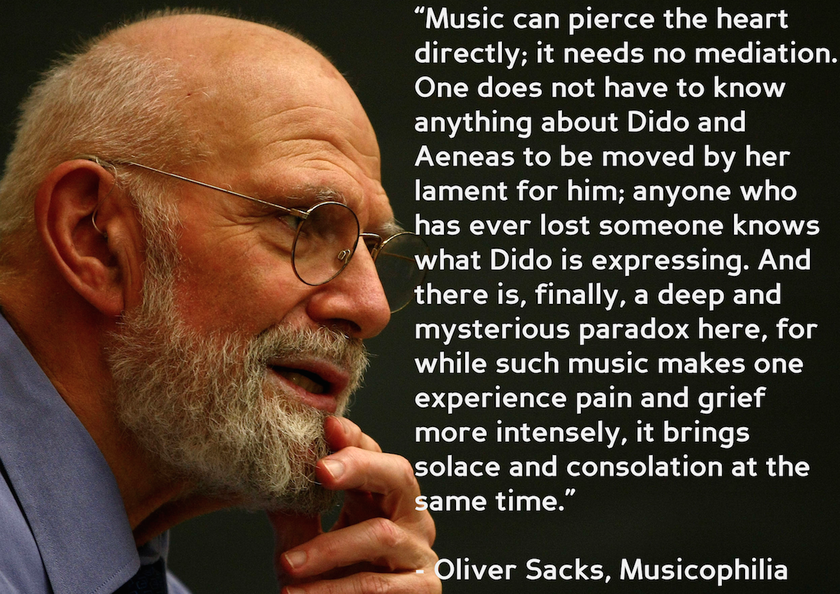
Music can take you to places you have never been before, wish to go to, wish to avoid, and help you navigate all of them. It is rhythmical geography for the soul. When it comes to the end of a cherished life, it is a memory restorer/curator, sort of like a musical picture album for the mind.
I played music this week for dozens of people. It is almost always affirmed by a smile, a nod of recognition, joining in and singing with the tune, a reminder of other songs, a piece of history that seems long lost. Music resurrects the life or a slice of it long assumed dead. It can bring back joy and courage and resilience, even healing when it is properly used.
A while back, I entered a room of a client and began to play hymns softly on my harmonica. I routinely do this and my charges are not surprised or bothered by it. They just know that pastor Marty has his harmonica in his left hand and he will likely play me a tune or two. As I played This is My Father's World, my client began to sing the words of the light and airy hymn. Her mood improved and her day was brighter. The nurse and others in the room were somewhat surprised because they had not seen this side of the client, the memories of a hymn that came flowing from her mouth so easily. I think it was a bit of a shock actually. It was assumed that there was not much left of her mind, nothing reserved for lucid speech anyhow. It even surprised me a little bit.
It has pushed me to research more and play more music. To be able to see family members smile as their loved one sings along when they thought all that has been lost, is a magical moment. A restorative moment. A healing moment. A hopeful moment. A musical moment.
On occasion, I have played music and within seconds of conclusion, the loved one goes to sleep for the last time. When family is present, this is often the most peaceful memory they could wish for. It stuns me how this happens, but then I remember the power that music has to bring one close to God and thankful for life on earth and prepared for life hereafter.
A lot of communication goes on when music is involved.
Laughter
Death is no laughing matter. To make fun of anything at or near the time of death is risky. My advice is don't do it. I have done it and regretted it and done it and thought it good. It is still risky. You need to have a good reason and good delivery and good timing, or it will be remembered as the foolish attempt to make things better.
So when is humor appropriate? And how do you use it? I recently officiated at a funeral where the deceased left me clear instructions to be funny at his funeral. None of this moping stuff. He was a stoical, hardworking, accomplished man and he had little time for tears. Needless to say, there were plenty of tears at his funeral, but I did my best to be funny. Of course, I told everyone that if they laughed at anything I said, it was his fault because he told me to be funny. We used to trade jokes when I visited him. He had some good ones, some I could use and some I couldn't, and some bad ones, some I could use and some I had to lose. But humor was a part of our journey together before he died.
I really got to know this man and his family. I was a part of them for a while. That is why I hardly every use humor with someone I have just met or right at the start of our relationship. That kind of humor says more about my fears or insecurities at that first meeting than it does about how I might minister to the patient. No, humor is too valuable to waste it like that.
Green lights for humor. When they are funny first. When they smile easily or laugh at something you say. When they give you permission to tell a joke. When they are sad and you ask them if they would like to hear a joke or a funny story. Get permission first, at least the first few times.
When people ask me what I can do for them, I have a short list, Pray and stay, smile a while, play some music on my harmonica, share Scripture, and I often tell them, I can tell bad jokes. Jokes and music are almost always welcome, even in the most devoted and religious patients.
Some jokes are without strategic purpose, except to lighten the mood and get someone to laugh. There is medicine there, right? But I use funny stories to get a conversation going.
A woman arrived at the Gates of Heaven. While she was waiting for Saint Peter to greet her, she peeked through the gates.
She saw a beautiful banquet table. Sitting all around were her parents and all the other people she had loved and who had died before her. They saw her and began calling greetings to her "Hello - How are you! We've been waiting for you! Good to see you."
When Saint Peter came by, the woman said to him, "This is such a wonderful place! How do I get in?" "You have to spell a word," Saint Peter told her.
"Which word?" the woman asked.
"Love."
The woman correctly spelled "Love" and Saint Peter welcomed her into Heaven.
About a year later, Saint Peter came to the woman and asked her to watch the Gates of Heaven for him that day.
While the woman was guarding the Gates of Heaven, her husband arrived. "I'm surprised to see you," the woman said. "How have you been?"
"Oh, I've been doing pretty well since you died," her husband told her. "I married the beautiful young nurse who took care of you while you were ill. And then I won the multi-state lottery. I sold the little house you and I lived in and bought a huge mansion. And my wife and I traveled all around the world. We were on vacation in Cancun and I went water skiing today. I fell and hit my head, and here I am. What a bummer! How do I get in?"
"You have to spell a word," the woman told him.
"Which word?" her husband asked.
"Czechoslovakia."
Now that is funny. More importantly, it's useful as a lead into questions about heaven, who's going, how do you get there, who decides whether you get in and more. That story allows me to share the good news of God's plan for a Forever Friendship with God. I like to share Psalm 100 after I tell that story. Here is the Message version.
Psalm 100The Message (MSG)
A Thanksgiving Psalm
100 1-2 On your feet now—applaud God!
Bring a gift of laughter,
sing yourselves into his presence.
3 Know this: God is God, and God, God.
He made us; we didn’t make him.
We’re his people, his well-tended sheep.
4 Enter with the password: “Thank you!”
Make yourselves at home, talking praise.
Thank him. Worship him.
5 For God is sheer beauty,
all-generous in love,
loyal always and ever.
Sing yourselves into His presence. So God must love music. I'm glad for that, being a musician. And he must love to laugh, because it says bring a gift of laughter as well. Hallelujah, God likes to laugh. And it almost looks like He requires it to get into heaven. The third requirement in this Psalm is Gratitude. Knowing where your blessings come from and offering thanks and praise to God for them. Gratitude, or as Peterson puts it in the Message, the password to heaven is "Thank You."
So sing and get funny and thank God for all of it.
Humor: purposefully employed can open up a world of conversations and gently open closed doors to what is often a difficult and painful subject, Death. Presented well, a funny story can help one show up at the gates, all so well prepared for that face to face meeting with an enchanting and accepting God who loves to laugh and sing and fellowship with His children. Master humor and God will teach you how to make a difference with your funnies.
What do you call a Rabbit with Fleas. Bugs Bunny. That's all folks.